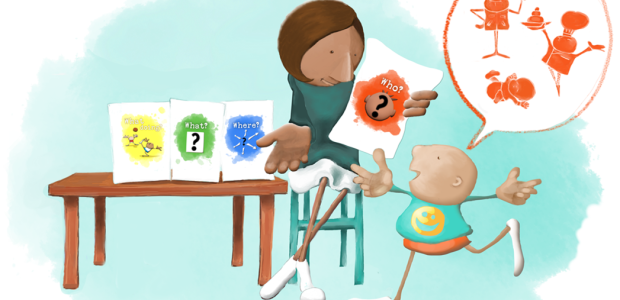
Over the years, many schools and speech and language professionals have used Colourful Semantics (developed by Alison Bryan) and Shape Coding (developed by Susan Ebbels) to support children’s understanding and use of grammar.
Originally, these two systems were separate. However, many years ago, some elements of Colourful Semantics were carefully adjusted so that children could begin with it and later move seamlessly into Shape Coding if they needed more detailed or complex grammatical support, particularly children now identified as having Developmental Language Disorder (DLD).
These changes also helped children and staff transfer more easily between schools, some of which used Colourful Semantics while others used Shape Coding.
What Changed?
Here’s an overview of the key changes made to Colourful Semantics to better align it with Shape Coding:
- Adjectives / Describing Words
Originally ‘blue’ in Colourful Semantics, adjectives were changed to a clear cloud shape, matching Shape Coding’s way of showing adjectives. - Auxiliary and Copula Verbs
Verbs like is, was, were, has, were put in yellow diamonds, drawing the diamond symbol from Shape Coding. - WHERE
This changed from the original red to blue to align with Shape Coding’s colour for prepositions. - HOW and WHEN
The colour for HOW became black (matching Shape Coding’s adverbials), while WHEN remained brown (not directly linked to Shape Coding).
Why This Matters
This integration, agreed as a trial with Susan Ebbels, allowed the two systems to complement each other rather than compete. Children who began with Colourful Semantics could build a strong foundation and then progress to Shape Coding for more complex grammar work if needed.
For schools and professionals, this meant greater consistency, smoother transitions, and a more unified approach to supporting language development.
Looking Ahead
By blending the strengths of Colourful Semantics and Shape Coding, educators and therapists can provide a more flexible and responsive framework. This evolution shows how collaborative thinking can lead to better outcomes for children with language needs, especially those with DLD, (Developmental Language Delay).
Training
Read to take the next step and find out more about Colourful Semantics and Shape Coding? Register on one of our upcoming training courses here.