The Picture Exchange Communication System (PECS) is an invaluable resource, which can be used with children and young people with Autism Spectrum Conditions and other communication difficulties. PECS does not require complex or expensive materials and can easily be used in school, home or in the community.
What is PECS?
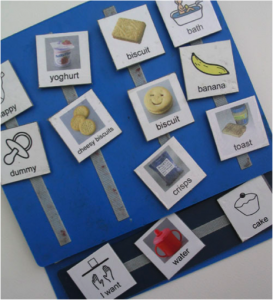
PECS is a type of Augmentative and Alternative Communication that uses visual symbols to teach the learner to communicate with parents, carers, teachers and peers. The aim is to teach intentional, functional communication and to allow users to communicate their wants and needs.
The PECS approach occurs in 6 phases.
- Phase 1 – Teaches the user ‘How to communicate’
- Phase 2 – Teaches ‘Distance and persistence’
- Phase 3 – Teaches ‘Picture Discrimination’ (although some users develop in Phases 1 & 2)
- Phase 4 – Teaches the user to build a ‘Sentence structure’
- The later stages include using ‘wait’ and ‘no’ with users and teaches attributes and additional vocabulary.

The exchange initially involves the user, a communication partner and a physical prompter. The physical prompter is required in the early stages, when teaching the exchange. However, as the user becomes more skilled there only needs to be a communication partner.
Who can PECS be used with?
PECS can be used with children and adults with a range of Speech, Language and Communication Needs (SLCN).
It is frequently used with children and adults with Autism Spectrum Conditions and those who have little or no verbal communication.
Who can implement PECS?
PECS is a highly structured system and its effectiveness and efficacy is based on consistent use of the system. Almost anyone can implement PECs, however they need to receive PECS training. Professionals, parents, carers, teachers, siblings and peers have all learnt to effectively use PECS and value their role as a Communication Partner.
Our therapy team can advise you on how you can implement PECS in your home or setting.
When is PECS used?
At every possible opportunity! PECS becomes the users voice, and they should have access to the system at all times. PECS can be used anywhere; at home, school, and during community activities. PECS books are made portable so that they can be used frequently in a range of settings.
Why use PECS?
PECS is a well known and researched communication system, and has enabled many user with little or no communication to express their needs and desires. PECS;
- Helps develop intentional communication
- Reduces negative or challenging behaviours caused by frustration
- Increases opportunities for interaction and learning
- Develops social skills and ability to build meaningful relationships
- Improves Spoken Language skills
A Neuro-Affirming Approach to PECS
The Picture Exchange Communication System (PECS) can be implemented in a way that is both evidence-based and neuro-affirming.
A neuro-affirming approach recognises that communication is diverse and that there is no single “right” way to communicate. PECS is viewed as one communication option that can support an individual to express themselves, rather than as a tool to make them communicate in a more neurotypical way.
When delivered in a neuro-affirming way, PECS should:
- Support an individual’s autonomy, choice and self-advocacy.
- Respect and value all forms of communication, including speech, gesture, signing, AAC, body language and picture exchange.
- Be used alongside other communication methods where appropriate, rather than replacing them.
- Follow the individual’s interests, motivations and meaningful reasons to communicate.
- Focus on increasing functional communication, participation and quality of life, rather than reducing autistic characteristics or encouraging masking.
- Be introduced flexibly, recognising that communication needs and preferences may change over time.
- Celebrate successful communication in whatever form it takes.
The aim is not to change who a person is, but to remove communication barriers, increase opportunities for meaningful interaction and empower them to communicate in the way that works best for them
Further Information
Click here for our free PECS symbols that are ready for download.
For further information about how to implement PECS, contact our team where one of our therapists will be happy to help.
Images © Copyright of PECS